Complete
You reached the end and produced enough evidence to evaluate the attempt.
The GuitarGod Method
The Method turns aspiration into attempts, attempts into measured evidence, and evidence into the next bounded drill—without confusing activity, completion, and mastery.
Streaks and XP can motivate. They never substitute for capability evidence.
Three different states
Collapsing these states creates false progress. GuitarGod keeps each transition explicit and evidence-backed.
You reached the end and produced enough evidence to evaluate the attempt.
The take met the current pitch and timing contract at the attempted tempo.
Clean evidence survives spaced re-tests, context changes, and time—not one good run.
The practice cycle
The cycle starts with a musical intent and ends only when improved capability transfers back into music. Analysis exists to shorten the path between those points.
Choose a musical outcome: a song, riff, technique, score, or re-test.
Play against a bounded target and preserve the original dry take.
Separate pitch, timing, confidence, tempo, and transition evidence.
Route the most useful corrective drill from the measured blocker.
Return to musical context and test whether the fix transfers.
Raise tempo, complexity, duration, or context only after evidence supports it.
Retention over streaks
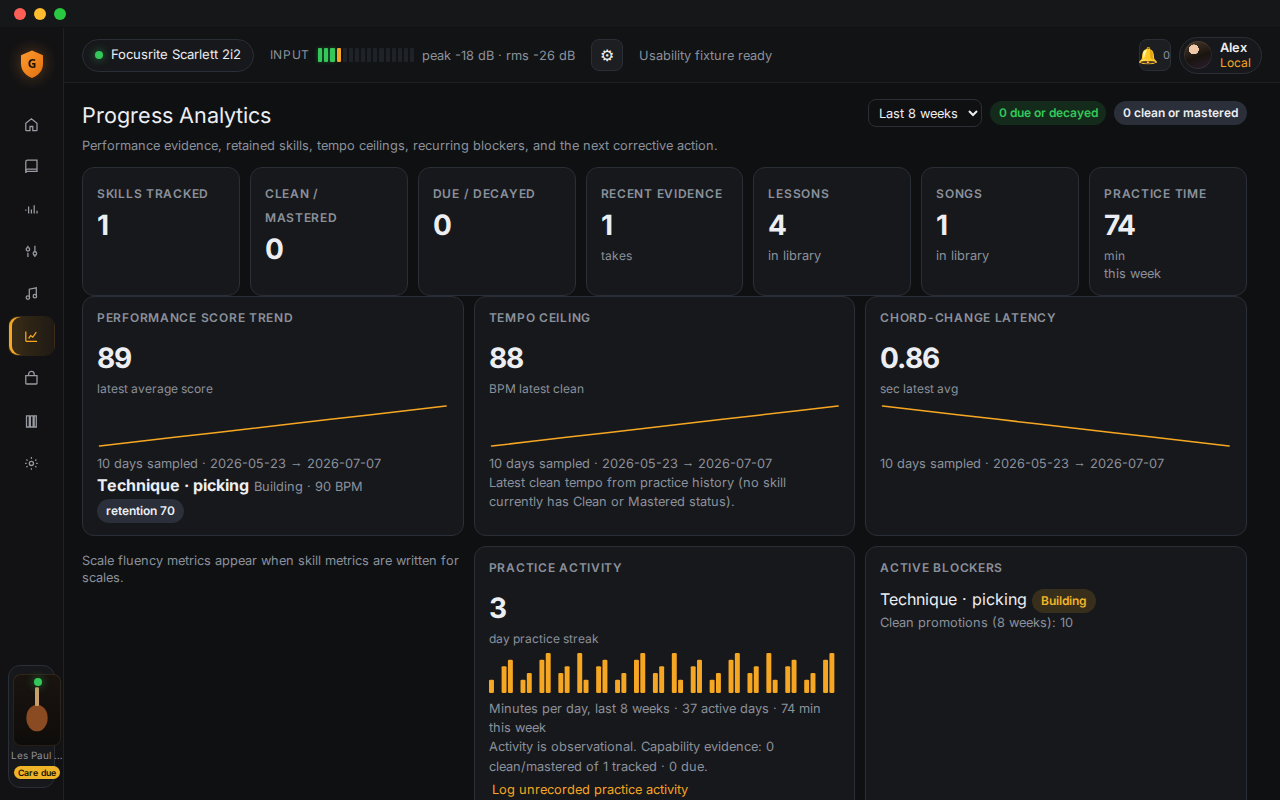
Skills become due, decay when evidence ages, and return for spaced re-testing. Progress Analytics keeps tempo ceilings, chord-change latency, scale fluency, retention, and recurring blockers tied to actual takes.
Honest interpretation
Lesson-aware scoring can compare a take to explicit expected events. Free-play transcription and chord interpretation cannot recover every physical detail, so GuitarGod carries confidence and asks for review where evidence is ambiguous.